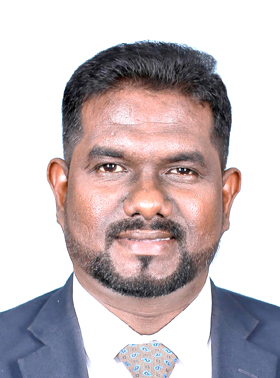
The Hon. Sundaralingam Pradeep - Deputy Minister of Plantation and Community Infrastructure
The Deputy Minister supported the sovereign debt restructuring process, arguing that it has helped restore financial stability, lower interest rates, and preserve social welfare measures such as increased Aswesuma payments. He highlighted longstanding poverty, housing, land, health, education, wage and employment issues affecting the hill-country estate community, noting that many still live in old line rooms without proper addresses. He said the Government, through measures such as the Hatton Declaration and anti-corruption efforts, would address land and welfare issues, and requested assistance from India and Tamil Nadu in resolving estate community problems.
Verbatim record (translated)
Machine-translated from Sinhala / Tamil / English¶ 01 Hon. Presiding Member, I am pleased to participate in today’s Adjournment Debate on international sovereign debt restructuring aimed at stabilizing Sri Lanka’s economy, ensuring financial stability and fostering development.
¶ 02 I represent the estate community in Ratnapura District as well as our Sinhala brothers and sisters living there. My late father was a fighter for the underprivileged during extraordinary times; as his son, I am proud to represent Parliament.
¶ 03 Our hill-country people have been in Sri Lanka for about 201 years, yet many of their issues remain unresolved, especially in education, health and the economy. Over 150,000 in my community still live in “line rooms” built 150 years ago; I too still live in such a line room. As the National People’s Power, we understand their problems. Through the “Hatton Declaration,” we will resolve land issues. We will take the lead to solve these in the coming period.
¶ 04 Estate workers were the backbone of Sri Lanka’s economy. In the 1950s-70s, the revenue earned from tea and rubber workers funded development of transport, ports, health, schools, and roads. Yet around 52 per cent of hill-country people still live below the poverty line. This is tragic.
¶ 05 I also wish to record that the UNP Government that came to power in 1977 orchestrated the 1983 violence and banned the JVP, which was operating democratically. The sacrifices of many fighters against those atrocities have led to the change today.
¶ 06 Our Party Leader and President Anura Kumara Dissanayake is currently visiting India and receiving a great welcome, which makes us proud as Sri Lankans. I request the Governments of India and Tamil Nadu to help resolve the estate community’s problems.
¶ 07 Under the ongoing sovereign bond restructuring, social welfare through “Aswesuma” has significantly benefitted estate people. Four categories receive assistance, and the Government has decided to increase benefits: from Rs. 15,000 to Rs. 17,500 for the extremely poor; from Rs. 8,500 to Rs. 10,000 for the poor; and from Rs. 2,500 to Rs. 5,000 for vulnerable groups. This is real relief.
¶ 08 Due to the economic crisis, estate people have suffered greatly. Many estates are no longer providing work; lush plantations have become forests. These enhanced payments will provide some comfort to the unemployed. About 1.7 million people benefit from Aswesuma.
¶ 09 Despite having been the economy’s backbone, the plantation sector is now in crisis. Around 52 per cent of estate people are still below the poverty line. The daily wage remains only Rs. 1,350; they are still daily-wage workers, face unemployment, and increasing illness. How can a family on Rs. 1,350 a day provide nutritious food as doctors advise?
¶ 10 Debt restructuring has also reduced interest rates gradually, helping small businesses and those seeking housing loans. This will help reduce poverty in the estates. Financial stability has been restored. The IMF has not curtailed social welfare through this restructuring; it has allowed continuity, which is a small consolation for our estate people.
¶ 11 Most youth in the estates use autos and motorbikes, not luxury cars. Therefore, fuel price reductions will especially help the grassroots.
¶ 12 Corruption has greatly harmed our estate people. In the past, they had to pay bribes to meet their needs. By eliminating corruption, our people can meet their needs fairly.
¶ 13 About 150,000 people in the estates still live without proper addresses, in line rooms. My own address is No. 01, Lower Division, Obathawatta, Kahawatta – 280, අංක 1, පහළ කොටස, ඕපාතවත්ත. Our brother Sunil knows it well.
¶ 14 There is a folk song about our people’s suffering: “Climbing steep hills to pluck coffee; if one berry fell, the supervisor beat them.” Even today, when they try to build a toilet, they are obstructed; when they build small houses in front of their rooms or behind, they are obstructed.
¶ 15 With the change in Government, the NPP will treat estate people as human beings and implement plans to improve their lives so they can live in dignity. Thank you.
Provenance
- Source
- Hansard, Tuesday, 17 December 2024 ·No. 1734685396083959 ·English daily/uncorrected Hansard
- Page · column
- not yet extracted — page/column anchors are not in the current dataset; the source PDF is the citable location.
- Permalink
/lk/speeches/18289
Cite as: The Hon. Sundaralingam Pradeep - Deputy Minister of Plantation and Community Infrastructure. 10th Parliament, Parliament of Sri Lanka. Hansard, 17 December 2024. No. 1734685396083959. Politick, https://staging.politick.io/lk/speeches/18289