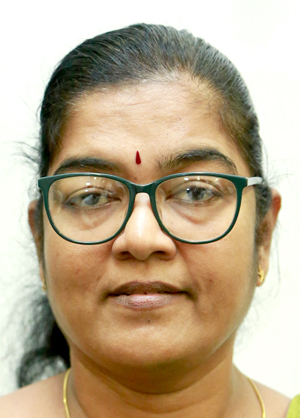
The Hon. (Mrs.) Saroja Savithri Paulraj - Minister of Women and Child Affairs
The Minister said the Government’s planned education reforms are intended as a systemic change rather than a syllabus revision, beginning with Grade 1 in 2026 and aimed at preparing students for work and society by around 2035. She said the reforms will shift education away from an exam- and marks-centred model toward concept-centred, activity-based learning, particularly in mathematics, science and languages. She outlined the national goals of education and said the reforms will focus on communication, personal development and environmental skill sets to support national unity, democratic values, adaptability and future employment needs.
Verbatim record (translated)
Machine-translated from Sinhala / Tamil / English¶ 01 Hon. Deputy Chairperson of Committees, thank you for the opportunity. First of all, I will pay my fullest attention to the issues the Hon. Member raised in his speech. Thank you very much, Hon. Member.
¶ 02 Regarding the educational reforms we intend to implement, I wish to say at the outset that educational reform is not merely updating or changing syllabi and introducing a new set of lessons in place of the existing ones. What we expect is a reform — a change — of the education system itself.
¶ 03 As the National People’s Power, we embarked on our political journey with a clear objective to formulate national policies for national education, national health and national transport, as well as for the environment and national unity. Today, with state power, we have the opportunity to implement new educational reforms within this new policy framework.
¶ 04 Thus, reforming education goes beyond changing the list of lessons in a grade. The first step we are taking is to begin a distinctly Sri Lankan policy to create a global citizen fit for the future world. The Prime Minister, as Minister of Education, together with the President’s policy statement, has set out what we, as a Government, have presented. We are not attempting to force final, rigid reforms upon society.
¶ 05 This will commence with Grade 1 in 2026. Accordingly, a child sitting for the Ordinary Level in 2031, and then for the Advanced Level by 2033, will finally become a citizen in society. A child entering Grade 1 next year will complete education and enter the world of work by 2035. Therefore, the reforms we design today must look beyond 2025 to align with where the world will be in 10 years — the world of services, jobs, and the labour market — and produce a student suited to that future. Hence, beginning in 2026 from Grade 1, this is not a mere curriculum update; it is a systemic change aimed at producing a learner suitable for the 2035 world of work. Education must be timeless — adaptable to every era — moving away from a narrow, exam-and-marks-centred approach toward concept-centred education.
¶ 06 We often say: we teach mathematics but children miss mathematical concepts; we teach science but they miss scientific concepts in social use; we teach language in all media but miss the concepts of language. We need learners who go beyond performing arithmetic to expand thinking on the basis of mathematical concepts. Therefore, we will introduce conceptual foundations in mathematics, science and languages. From Grade 1 onward, activities will go beyond the textbook so children internalize daily mathematical concepts through activity-based learning.
¶ 07 Sri Lanka’s education has eight national goals, including: fostering national unity, integrity and peace within a multicultural society founded on respect for human dignity; responding to challenges in a changing world while recognizing and preserving national heritage; creating a democratic, socially just environment that nurtures respect for fundamental rights, responsibilities, empathy and care; promoting sustainable lifestyles based on mental and physical well-being and human values; developing creativity, initiative, critical thinking, responsibility and accountability for a balanced personality; developing human resources for productive work to improve quality of life and contribute to economic development; preparing individuals to adapt to rapid change and manage complexity and uncertainty; and cultivating attitudes and skills based on justice, equality and mutual respect to secure an honourable place among the international community.
¶ 08 To realize these eight goals, we target four foundational skill sets: - Communication skills: literacy, numeracy, visual literacy, and ICT proficiency. - Personal development skills: creativity, divergent thinking, initiative, decision-making, problem solving, critical and analytical thinking, teamwork, interpersonal relations, inquiry and research. - Environmental skills: engaging with social, biological and physical environments in a socially responsible manner. - Life and work skills: work readiness, religious and ethical understanding, sports and leisure, and learning to learn.
¶ 09 Thus, our aim is not merely a certificate but a student with the skills and national goals realized — the future human who will enter the world of work by 2035. We will ensure 13 years of compulsory education. A child formally entering school at age five will continue uninterrupted for 13 years and enter society at 18. At that moment, we can reduce child marriage, protect children from violence and crime, create an informed society, achieve gender equality, and reduce the number of child mothers. Within the school system, no child should be subjected to violence or crime; there must be room for play, joy in learning, and a reduction of the physical burden of schoolbags and the burden placed on parents.
¶ 10 These reforms, introduced in 2026, are open to contributions from the Opposition, social actors, educators, and all interested. There is still room for revisions. This is not a rigid finality; our initial rollout is next year with time up to 2031 for adjustments. We invite all of you to submit your views and proposals.
¶ 11 We also need alternatives for children who drift away from education. Not every child grasps mathematics or science; not every child excels in sports or music. Children have diverse talents. Our system must recognize this diversity. Beyond O/L and A/L, alternative pathways are limited, causing children to drop out. Hence we will emphasize humanities and social sciences alongside vocational education.
¶ 12 In conclusion, we will integrate humanities subjects such as history and civics within the humanities stream, which is essential for developing imagination and soft skills. Alongside this, vocational subjects are crucial to build a learner suited to the future world of work. Therefore, within these reforms, we prioritize practical vocational subjects while giving due value to the humanities. From 2026, we will provide balanced education across humanities and vocational-technological subjects so that no child is left behind. We will create a safer world for children and nurture future citizens with balanced character and soft skills suited to the workplace.
¶ 13 The world is moving toward a knowledge economy. Through our reforms — grounded in environment, information, infrastructure, media and empowered human resources — students will gain knowledge that cannot be measured only by exams, while still receiving the credentials needed for future work, and developing humane attributes with empathy. This is a balanced education system. These reforms are open to your ideas and proposals. I conclude.
¶ 14 Thank you.
Provenance
- Source
- Hansard, Thursday, 24 July 2025 ·No. 1754026625097211 ·English daily/uncorrected Hansard
- Page · column
- not yet extracted — page/column anchors are not in the current dataset; the source PDF is the citable location.
- Permalink
/lk/speeches/18576
Cite as: The Hon. (Mrs.) Saroja Savithri Paulraj - Minister of Women and Child Affairs. 10th Parliament, Parliament of Sri Lanka. Hansard, 24 July 2025. No. 1754026625097211. Politick, https://staging.politick.io/lk/speeches/18576