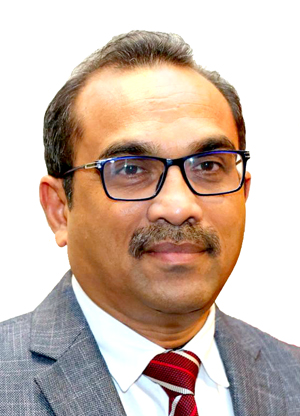
Hon. Bimal Rathnayake
Hon. Bimal Rathnayake argued that the escalating Israel-Iran conflict should not be fuelled by other states and called for urgent negotiations, while noting risks to Sri Lankan citizens abroad and possible economic effects such as rising oil prices. He linked the conflict to the unresolved Palestine question, stating that the failure to establish a free Palestinian state alongside Israel has prolonged instability and led to severe humanitarian consequences. He urged responsible international action, criticized the justification of military escalation as self-defence, and cautioned against blaming entire populations for the actions of their governments.
Verbatim record (translated)
Machine-translated from Sinhala / Tamil / English¶ 01 This is based on the Palestine question. As I speak, the UN Security Council is meeting. However, when a war breaks out between two states, what responsible countries around the world ought to do is not to fuel it. Both these countries possess certain strengths. As for Israel, to my knowledge it uses a portion of the United States’ nuclear arsenal. As for Iran, whatever the debate about whether it possesses nuclear weapons, for about 45–46 years it has been a country under severe sanctions. After the 1979 political struggle, Iran, with immense internal strength, developed its technology and science. Therefore, many may not fully understand Iran’s capabilities.
¶ 02 Another point is that Iran has a population of about 90 million and an ancient civilization. When conflicts arise between power centers like these, the duty of all countries is to bring the parties rapidly to a negotiated settlement. That is what we too believe should happen. We regret that this war is escalating. Many countries are effectively encouraging Israel to prosecute this war, under the pretext of the right to self-defense. But how can the right to defend oneself extinguish others’ rights? We all know the Israeli government has attacked almost every country in that region in recent times.
¶ 03 Let me also say this: while criticism of the Israeli government’s political actions is warranted, it is wrong to generalize that to the entire Israeli populace. I personally believe the government’s wrongs are evident. But that does not mean we must be against all Israelis. If the Israeli people wish, they should be the ones to change their government; if they want to keep it, that is their choice. What is happening today, however, is that people in two countries are dying to satisfy the desires of the war business and political objectives. We must state clearly: this problem persists because Palestine has been denied the space to establish a free state. Palestine is not some strange land; it is the world’s last colony in Asia, the last remaining territory under domination. Before 1947, there was a country called Palestine. Just as the British imperialists divided our country into Sinhala, Tamil, Muslim, Burgher and Malay to foment conflict, and partitioned India, they did the same there. Even today, India and Pakistan clash. Look into how the British partitioned India; they carved it along religious lines, and people still suffer those consequences.
¶ 04 Recently there was a major issue between India and Pakistan. With the same imperial objectives, the people who had a country called Palestine were rendered stateless. Elsewhere, people fight to form a new state; Palestinians are fighting because their pre-existing sovereign state was taken from them. The world bears responsibility here because Israel was created with the concurrence of the United Nations, on the basis that both a free Palestinian state and a free Israeli state should be established. But global powers helped create one state—Israel—while failing to establish the Palestinian state, which has been steadily diminished. Of the land taken in 1947 to create Israel, only about 10–11 percent now remains with Palestinians.
¶ 05 On top of that, there are massive inhumane killings. It is visible that especially the leaders of the United States don’t seriously consider these killings. What are the consequences? We must ensure the safety of our citizens in those countries. We also know oil prices could rise. For all our talk here, the maximum we can do is protect our citizens in those countries—some of whom are already injured. The vast social and economic consequences of war can only be halted through a united approach. Leaders must act responsibly; warmongering will not work.
¶ 06 What are the consequences of these wars? Iraq was destroyed, resulting in a massive refugee crisis. When Israel bombs Palestine, America catches fire; Los Angeles and New York catch fire; Europe becomes one refugee crisis. If this war spreads, that refugee crisis will again hit Europe. A small group of world leaders use war to cover up their political failures.
¶ 07 When war breaks out, people watch it like a match, seeking the thrill—some even flock to see buildings collapse. But imagine your child is inside that building. Today, one side is selling this war.
¶ 08 Finally, the consequences of an Israel–Iran war will be felt not only by those countries’ peoples, but by the entire world. Especially the United States and Europe are now in serious socio-economic crises due to wrong decisions by their leaders. Afghanistan was shattered; Iraq shattered; Syria shattered; Libya shattered. Where is the peace that resulted?
¶ 09 We may be a small country, but we are a sovereign state. The Sri Lankan government and people have a responsibility to do what we can to establish Palestine’s freedom. As a sovereign nation, without siding with war-mongers, we should exert whatever influence we can to immediately stop the war between Israel and Iran. Some may scoff, asking whether we can stop a war. But even our voice matters. If we want a safe environment, we must at least intervene with our words. With that emphasis, I thank you for the opportunity.
Provenance
- Source
- Hansard, Friday, 20 June 2025 ·No. 1751600792021434 ·English daily/uncorrected Hansard
- Page · column
- not yet extracted — page/column anchors are not in the current dataset; the source PDF is the citable location.
- Permalink
/lk/speeches/1929
Cite as: Hon. Bimal Rathnayake. 10th Parliament, Parliament of Sri Lanka. Hansard, 20 June 2025. No. 1751600792021434. Politick, https://staging.politick.io/lk/speeches/1929