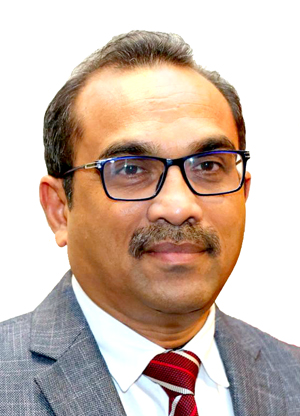
Hon. Bimal Rathnayake
Hon. Bimal Rathnayake compared the 2025 local government results with previous elections, arguing that the NPP’s current position represents a significant advance from the JVP’s 431 councillors and no council control in 2018 to majorities in 267 councils and over 3,500 councillors. He contrasted this with declines in the SJB and SLPP, stating that the SJB had fallen from 34 councils and 2,433 councillors to about 14 councils and 1,700 councillors, while the SLPP had fallen from 231 incumbent chairmen and 3,436 councillors to no councils under its control and about 742 councillors. He argued that opposition councillors have limited national political impact and said the JVP/NPP’s earlier experience in organizing local councillors gave it an advantage over rival parties.
Verbatim record (translated)
Machine-translated from Sinhala / Tamil / English¶ 01 Let us then take the Janatha Vimukthi Peramuna (JVP). At that time we were building the National People’s Power (NPP). We contested the 2018 Local Government Election as the JVP. In that 2018 election, the people did not give us control of even a single local authority. What we obtained were 431 councilor posts with 6.27%.
¶ 02 Hon. Presiding Member, if we compare this to the local government situation in 2025, the Sri Lanka Podujana Peramuna (SLPP) had 231 chairmen—those were incumbent chairmen. They had 695 chairmanships across bodies, and 3,436 councilors who were sitting then. We had 431 councilors. Out of those 431, about 75 to 100 have since come to Parliament. When comparing local government results, the SLPP’s so‑called February revolution of 2018 did not begin from zero. They reduced to 231 chairs after having already held power in 270 local bodies. We know that at that time the country faced political instability, factional conflicts, and an economy that was collapsing. Therefore, the public had a desire to change the SLPP, and turnout increased—those were the conditions then. But today, none of those conditions exist. Today there is neither such a problem for the government nor an opposition that can even get close to us.
¶ 03 If the SLPP gained some strength in 2018, they were climbing the next mountain starting from an existing peak—270 councils and 2,611 councilors—to reach where they did in 2018. Now, if you look at the current local authorities, how should we look at them?
¶ 04 You know that, truly, the closest representative to the village is the Chairman or a Member of the Pradeshiya Sabha (local council). You also know that, of the 159 MPs here, more than 100 are newcomers to Parliament. Then, if we start from zero, where have we reached now through the local government elections? Hon. Presiding Member, looking at the local authorities as of 2025, where have we reached? We have secured majorities in 267 councils and 3,927 councilor positions. The NPP alone has secured more than 3,500 councilors.
¶ 05 Next, let us look at the situation of the SJB. I said that in 2018 their government was in office. Yet they won only 34 councils and 2,433 councilors. What is the SJB’s status today? Hon. Presiding Member, today they have 14 councils, and only a smaller portion of those are where they can form full control. They do not have 140 councils. How many councilors do they have? They have about 1,700. Up to 2025, you had 2,433 councilors. If you try to hide behind words, the SLPP can do the same. If you say there is no JVP, only the NPP, we could say the same. Let us speak real politics. Do not interrupt, Hon. Member; even your case has fallen. What I am telling you is this: if we speak the truth, what is the reality? The SJB had 2,433 councilors and control of 34 councils. Today your councilors have reduced to around 1,700. Even if you ask Mr. Ravi Karunanayake and add the UNP’s numbers, you still do not get the earlier 2,400, and the 34 councils have reduced to 14.
¶ 06 What is the situation of the SLPP? They must look at it truthfully. Up to 2025, the SLPP had 3,436 councilors and 231 incumbent chairmen. Today the SLPP has no councils under its control. Their councilors number about 742. Hon. Presiding Member, as a party, we have known this terrain since 1997. Our first local councilors came in 1997—101 members. We know that an opposition councilor in a local authority has very limited impact on national politics.
¶ 07 How did we act? We brought those 101 together, created a fund, and built small things like school libraries from that fund. Through a completely united approach we built some value for those local councilors. Your parties cannot build such unity across even one council throughout the country. Your vice chairmen are always waiting to cut the chairman’s throat. The Rajapaksas now have 742 local council seats. What can those 742 do? Politically they can do nothing; it is politically disastrous. Therefore, comparing local government election results, we can say that the largest local authority victory in Sri Lanka’s history has been obtained by the National People’s Power. Accept that with humility.
¶ 08 Another fact we know: they say we are absent in the North. Hon. Presiding Member, some old pundits keep saying we are only in Maharagama. No. In the Vanni, our vote has increased. How did some parties run their campaign there? By distributing illicit liquor and cash—especially the Ilankai Tamil Arasu Kachchi. I state this responsibly. Ministers here know it better than I. They used crude communalism. We did not. Did we distribute even a cent? Even if we wanted, how much could we distribute? We did not run around promising “we will build this road.” We only mentioned a few roads approved under the Vote on Account. The Prime Minister is building thousands of schools; we did not tout a single school’s name. We did not buy any councilor with money. We did not use racism or fraud. With clean politics we have won around 4,000 local council seats.
¶ 09 What is the situation in the North? In the Vanni district, in Mannar, our vote has increased. Even today, the largest party in Mannar is the NPP. Not the set that carried shopping bags from Mannar to Puttalam and amassed assets you can’t carry back even in ships. In Vavuniya, the largest party is us. In Mullaitivu too, our votes increased. In Mannar, votes increased. Remember this: despite others’ communalism and dirty tricks in the North, in the Vanni the only party to have increased its votes is our National People’s Power—Thesiyamakkal Sakthi. If our Member Mr. Archuna were here it would be good, but he’s been expelled and cannot be asked.
¶ 10 Next, Jaffna district. Historically, our party did not have even a single local council seat in Jaffna. That is the truth. What is the position today? We now have 81 councilor seats in Jaffna district. If you add Kilinochchi, it is close to 100. In Jaffna, the ITAK has about 162,000 votes; that is true. They have controlled that region for decades—ministers, MPs, local body power—all held by them historically. We have about 150 councilor positions in the Northern Province alone—81 in Jaffna administrative district.
¶ 11 Hon. Presiding Member, what about Jaffna Municipal Council? Today, the party that does a lot of “lorry talk” has 13 seats. Hon. Ponnambalam’s ACTC has 12 seats. They have usually held the mayoralty there. Even his forefathers served as Jaffna municipal councilors. Thesiyamakkal Sakthi—our front—has, for the first time, 10 seats in the Jaffna MC. No one has a majority. How many does the SJB have? One. The UNP? One. We have 10 in the Jaffna MC. Who are they? Brand-new people, never even stepped into a local authority before. So in the North, we have around 150 members. In the Vanni district and across the Northern Province, we are the number one national political party there. Remember that.
¶ 12 What is the truth we know from this local government election? If we had any disadvantage, it is because many of our candidates were very new—never served in local bodies; never campaigned before. Therefore, especially under the ward system, those who had worked and had name recognition in villages inevitably got an advantage. I saw one TV channel owner now giving big “lorry talk.” If you check closely, Hon. Presiding Member, half of their talking heads are former Pohottuwa (SLPP) members. We do not have time to waste on that. They are ex-SLPP or from other parties; but how many are they? Then I saw, Hon. Presiding Member, the SJB saying—even Mr. Sajith Premadasa, whom I asked today whether he came to take oaths—claim they will take power. Amidst their mudslinging, smears and channel attacks, we still obtained 4.5 million votes in this election.
¶ 13 How many votes did those trying to grab power against us get? 2.2 million—21%. How much did you get at the presidential election? You got 32%. You did not even get that lesser amount now. There are many things to compare before a parliamentary poll. What I am saying is this: now they say we should hand over power. Some are even getting their outfits stitched to take oaths in December. Hon. Alawathuwala, you have your feet on the ground and you know this will not happen. This time you obtained 21%. You trail us by 2.3 million votes—22 lakhs to our 45 lakhs. Even if you double your total, it is not enough to catch us. Put these numbers and data into a parliamentary election model. Remember: the NPP will form a full majority government. When you model it, those one, two, three percent fragments will break away to nothing.
¶ 14 Hon. Member, if you make comparisons, do them properly. You cannot compare a dhamma school cricket match with a Test match. But you can analyze in reasonable ways. Numbers have no politics; though one can play politics with numbers, numbers themselves have no politics. What can be demonstrated from every angle? Compared to the JVP’s earlier 431 local seats, we have increased to 3,927—an increase of over 3,500—something unprecedented. We have majorities in 267 councils. We will constitute all 267 councils. Do not create needless trouble with lies; if we can, we will form even more. We know how to choose strategies without filth and without becoming arrogant. If we could not, would we have won the presidency, the premiership, and 159 seats in Parliament? With these figures I told you: we have won not just the North or East, but the whole country.
¶ 15 Next, consider the Colombo Municipal Council (CMC). What is its position? In the entire history, this is the first time that neither the UNP nor the SJB—both the same in two names—has obtained power in even one major municipal council. It is sad. Look at that seriously, or else you will never recover and will remain as you are for the next 75 years. Hon. Presiding Member, today what is said about us? That we did not reach our parliamentary vote tally this time. How much did the SJB increase this time compared to the parliamentary election? By 300,000. With an increase of 300,000, they talk of five MPs from the wards and four from the 75,000-lists, and 18 from the national list—making 45. Can you catch us with that? Have we been beating coconuts for the last four and a half years?
¶ 16 Next, look at the SLPP. Hon. Presiding Member, the SLPP had a special advantage—we acknowledge they had very strong chairmen. Mr. Basil Rajapaksa built very powerful chairmen—giving power, money, and leeway to do any dirty deed. You, coming from Tangalle, know how a chairman accused of raping and murdering a foreign woman was protected by the SLPP. You also know how in Hambantota MC, an underworld figure named Eraj came with a pistol against SJB members. He raised a pistol at them. The Rajapaksas did not arrest him. They built such chairmen as pillars of power. I do not think in Sri Lankan history anyone else made such powerful local chairmen. Those chairmen contested this time. Therefore, why are our votes lower than the parliamentary election? Because our local candidates were very new while theirs were very powerful incumbents. Remember from where they started—231 chairs and 3,436 councilors. That is the village reality we faced.
¶ 17 Also, you know we have had the government only for six months. We cannot complete village development in six months. We cannot hand unsolicited tenders to friends to build roads. We cannot do that. Therefore, some village development delivery has not yet reached the people; there has not been time to deliver. In that context—with nothing given—we still went to the polls. Meanwhile, they distributed rice, coconuts, food—this time too, like always. We do not do such things. Before our development projects could properly flow to villages, we held this election because we wanted it held. We were the party that went to court against postponement. There is a Supreme Court order to hold it early. We also needed to build our village machinery. We never wanted to crush the opposition; if we wanted, we had enough power to make any laws. That is what Hon. Chamara Sampath asked—whether we used our two‑thirds to smash coconuts.
¶ 18 Hon. Presiding Member, we, as a democratic government, use power properly. If we do not abuse it, you call us fools. We will not abuse it. We have now won 267 councils in this manner. Is that not enough? I told you many points. There were many interruptions, so my flow changed.
¶ 19 Hon. Presiding Member, taking the local election as a whole, our votes are lower than the parliamentary poll—clearly for the reasons I stated. But what do they now call us? Arrogant. Before thieves, we are indeed proud. Before rogues, we are proud. There are politicians with feudal mindsets; before them, we are proud. Before the people, we are the most humble.
¶ 20 Hon. Presiding Member, ask what happens in discussions with the President. Some of the most senior public officials in history first present their honest views to us. In the Finance Ministry or Education Ministry—we ask every official to speak; we invite their opinions. We decide collectively. You must have seen how Mr. Ranil Wickremesinghe handles his party group meetings, and how the Rajapaksas handle theirs. We are not like that. We give officials space, talk with them, and help them maximally. Our utmost humility and democratic spirit is with the officials.
¶ 21 We are very humble before ordinary people. But some have a problem. They treat their posts as their lifeblood and cannot bear when ordinary, fair people are handed leadership by the public. Some such sick persons and their followers exist on social media and a few channels. Their problem is that they see everything we do as wrong. Remember this: before enemies of the people, we are proud; before thieves who stood against the people, we are very proud; and before those who cannot accept the people’s mandate, we are even prouder. Before the people and ordinary officials, we are humble.
¶ 22 There is also a very large number who helped us bring this people’s mandate. We cannot consult every single one of them on everything. The Chairman of COPA is here. Hon. Member, there are many good people willing to advise you. But you too must have experienced that you do not have time at this moment to listen to everyone. In my view, as ministers and MPs, that is an inevitable challenge. We are willing to hear every piece of advice. But given our current duties, we do not have time to heed them all—not due to unwillingness. We are willing to learn even from a child. You know how much respect we give. Hon. Prime Minister is a learned woman of this country. You know how she respects a child—she comes down to the child’s level. Have you seen such a Prime Minister or such Presidents? Some say our votes decreased because we are arrogant; that is why I said this.
¶ 23 Finally, I want to say this. We take this people’s mandate very seriously. It is a great asset to us. I believe the NPP’s political, state, and administrative machinery became fully formed through this local election. Therefore, each of our MPs now has a council under them. Next Monday and Tuesday, together with you, we will go and constitute the councils. The plans are ready; we have shared them with the people; we will start implementation.
¶ 24 Hon. Presiding Member, we say clearly that in another six months our local councilors will turn the NPP into a true 6576 machine—into a nationwide machine.
¶ 25 Because we cannot attend every funeral house, wedding house, pirith house, or alms-giving; we cannot inspect every canal, every school, every dengue hotspot. But our 4,000 local councilors will do that work. From Delft Island to Dondra Head, we have councilors. If there were an election in Kachchativu, we would win a seat there too. From Delft itself we have members. Not just in Jaffna—everywhere. With those 4,000 councilors, we will work with the people in an unprecedented way. You may sleep or indulge in self‑delusion, listen to lies told by number‑spinning pundits, and be misled as you wish. Hon. Presiding Member, the SJB—the main opposition—has 148 local authorities. We have 267. We will establish over 150 administrations. We specifically state that. Hon. Alawathuwala, if you do the math, it will take 20 years to increase seats this way. Therefore, do not get trapped by numbers; take numbers as numbers. Do not twist them with politics to mislead—otherwise you will end up dressing up a buffalo.
¶ 26 Finally, I must speak about ugly politics. We ask analysts and intellectuals who speak of democracy: what is the people’s mandate? When the people give a party the largest number of council seats, it means they want that party to govern. Ignoring that, various parties and groups are now trying to cobble together administrations. If they had said so before the vote, fine. But that is not the case. After the vote, they are selling out for money and posts. We believe the people ended that dirty politics on 21 September. Even if we in the NPP refuse to do that, if others try to destroy democratic ethics in this country by doing so, we will not allow it. Therefore, we will form those 267 councils—if possible more—and from tomorrow morning we will start the match of developing Sri Lanka and serving the village.
¶ 27 Thank you, Hon. Presiding Member, for the opportunity to speak.
Provenance
- Source
- Hansard, Thursday, 8 May 2025 ·No. 1748426168056758 ·English daily/uncorrected Hansard
- Page · column
- not yet extracted — page/column anchors are not in the current dataset; the source PDF is the citable location.
- Permalink
/lk/speeches/21983
Cite as: Hon. Bimal Rathnayake. 10th Parliament, Parliament of Sri Lanka. Hansard, 8 May 2025. No. 1748426168056758. Politick, https://staging.politick.io/lk/speeches/21983