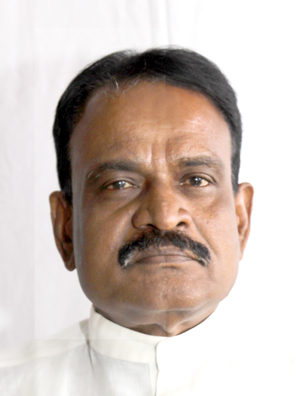
The Hon. Gnanamuththu Srineshan
Gnanamuththu Srineshan argued that decades of poor fiscal management, planning failures and ethnic conflict had weakened Sri Lanka’s economy, citing tax cuts, the fertiliser ban, continued import dependence and post-war stagnation. He urged the new Government to address past mistakes, complete 3,325 unfinished State-funded houses in Batticaloa District by allocating the revised requirement of Rs. 2,724.79 million, and provide fair support to flood-affected farmers. He also called for justice and meaningful redress for over 4,000 cases of enforced disappearance, rejecting inadequate compensation as insufficient for affected Tamil families.
Verbatim record (translated)
Machine-translated from Sinhala / Tamil / English¶ 01 Hon. Chairman, I participate in the Committee Stage debate on the allocations to the Ministry of Finance, Economic Stabilization and National Policies.
¶ 02 Finance, planning, and economic development should be the backbone of our country. Looking back, at Independence Sri Lanka was said to be fourth in Asia in economic stability, behind Japan and Malaysia. Since then, due to the conduct of successive rulers, the country has been pushed to a point where we borrow from Bangladesh. That shows how far finance, planning and development have been neglected.
¶ 03 An Indian poet once said of his country’s independence: “We expelled the white darkness only to embrace the black darkness.” Likewise, we can say: “In Sri Lanka, we threw away the foreigner’s shackles to wear the shackles made by our own.” At Independence we were fourth in Asia; after 77 years of our own rule, we have been dragged to the depths. We now borrow from Bangladesh, established in 1971. I say this with pain.
¶ 04 Since 1948 until 2024, UNP, SLFP and SLPP have ruled. In those periods there was no social harmony, economic development, or ethnic reconciliation. Now a new National People’s Power Government rules. Our people watch keenly to see what you will do. Only three months have passed; we cannot severely criticise you or expect you to correct in three months what went wrong over decades.
¶ 05 During the war we were told that as bomb tonnage increased, the country’s shrapnel (fragmentation) count also increased. We were told if war ends, the country will progress and the economy will be transformed. Sixteen years after the war, we are going backwards. Though bombs no longer fall, the fragmentation count rises. We must think deeply about what we are doing in finance, planning and development.
¶ 06 In the previous regime, grave mistakes were made in fiscal policy and planning. Taxpayers numbered 1.6 million; that was cut to 400,000, causing an estimated Rs. 600 billion loss. The fertiliser ban and wrong approach to agriculture caused an estimated Rs. 260 billion loss. This reflects bad fiscal management, bad planning, and bad politics. What will this Government do to correct matters?
¶ 07 On social development, food, clothing and shelter are basic. Under the National Housing Development Authority, many housing schemes were launched. In Batticaloa District’s 12 DS Divisions, 147 housing schemes were implemented. Of those, 3,325 houses remain half-built — at foundation, window-sill, lintel, unroofed, unplastered stages. These are poor people. The subsequent Government left them incomplete because they were started under a different Government. These are State-funded houses; leaving them to decay wastes public money.
¶ 08 This Government, which professes pro‑poor values, must complete these houses. In 2018–2019, the estimate was Rs. 1,235.47 million; the revised need is Rs. 2,724.79 million. I learn Rs. 85 million has been allocated. I appeal that you allocate the necessary funds and complete these 3,325 houses.
¶ 09 There are more issues from the past that a responsible Government must address. Under the previous regime, MPs and Ministers received generous compensation for losses, but poor farmers and direct producers affected by floods did not receive adequate assistance. Farmers form a vital part of rebuilding our economy and must not be forgotten.
¶ 10 On the forcibly disappeared, our community has over 4,000 cases. There has been no justice or compensation. When MPs and Ministers receive compensation, why not those who lost family members? When former Minister Wijeyadasa Rajapakshe tried to placate the issue by paying Rs. 200,000 per case, the families refused to be deceived. Their struggle continues. To value a lost life at Rs. 200,000 is to insult and diminish the Tamil people’s loss.
¶ 11 On planning: while we produced locally, imports continued as a route to earn commissions — sugar, garlic, onions, coconut oil, etc. Did these benefit the people? Or a few through commissions?
¶ 12 A productivity statistic (albeit dated) showed Japan’s productivity index at 60, India’s at 14, and Sri Lanka’s at 1.6. That reveals how unproductive and inefficient we are.
¶ 13 On development and the productive sectors: education, health, agriculture and industry are productive. War devastated us. We were told defence spending would reduce after the war and allow more funds for productive development. Instead, defence spending has increased to around Rs. 160 billion. Relative to population, Sri Lanka’s troop density is very high — e.g., in Mullaitivu two civilians per soldier; in Jaffna one soldier per 14 civilians. In a non‑war context, how is such defence spending justified?
¶ 14 Before and during the war, the Valachchenai paper mill in Batticaloa operated, employing over 4,000 and producing domestic paper. Today it barely functions with about 300 workers. The Government press at Kumburumunai no longer exists — not even foundations remain. The textile factories in Illupadichenai and Mandur are gone. Rice mills too. Of all factories in Sri Lanka, about 96–97 percent lie outside the North and East. In the East, factories are concentrated in Ampara; in Batticaloa and Trincomalee they have withered. If this Government intends to develop industry, reopen the closed factories in the North and East. Production and jobs will increase; brain drain will reduce as people gain employment at home.
¶ 15 We do not glorify “human capital flight,” but realities push professionals away. Recently, a female doctor in Anuradhapura was sexually assaulted — such incidents drive professionals abroad. For years, sexual violence, intimidation, and threats have pushed intellectuals overseas. Around 1.5 million Tamils live abroad. Canada’s current Minister of Justice, Arif Virani (Hari Anandasangaree), is a Tamil — had he been caught in 1983, he might have disappeared. I congratulate him. Though Tamils are treated as second-class citizens here, abroad they are respected and serve with dedication.
¶ 16 If the national question is resolved justly, we can bring back this human capital and uplift Sri Lanka. This new Government should create conditions to utilise that capital — by resolving the ethnic issue justly.
¶ 17 Other issues: Temporary workers hired for road works remain unconfirmed. Elephant protection guards recruited under the Department of Wildlife Protection remain temporary, earning only about Rs. 22,000 per month. Dengue control officers also remain temporary with low pay. The working class continues to toil on meagre wages; they must be regularised and paid fairly.
¶ 18 On welfare: the monthly public assistance (“dharma money”) for the poor, elderly and sick is only Rs. 250–500. Many must travel long distances and spend more than they receive. Increase these amounts and establish sub‑post offices or payment points near their residences to spare them travel.
¶ 19 On human rights: Recent revelations about the “Puththalama (Pattalanthe)” torture camp show horrific abuses — torture, murder, abductions, enforced disappearances. Similar abuses occurred across camps in the North and East — Saththurukkondan massacre (1990), abductions from the Eastern University and killings at Navalady, countless disappearances at Morakkottanchchenai, Kallady, Karadiyanaru, Uurani, Koddawettuvaan. Families still have no justice. Perpetrators who flouted human civilisation must be prosecuted.
¶ 20 For 77 years, no major grievance has been resolved through domestic mechanisms, which are weak and biased. International mechanisms are needed to address rights violations and provide justice.
¶ 21 People have seen green and blue governments. Now a red, left, equality‑speaking Government is in office. Let there be justice for all victims — irrespective of ethnicity, religion or region. That is the people’s expectation.
¶ 22 Thank you.
Provenance
- Source
- Hansard, Thursday, 20 March 2025 ·No. 1746596381071973 ·English daily/uncorrected Hansard
- Page · column
- not yet extracted — page/column anchors are not in the current dataset; the source PDF is the citable location.
- Permalink
/lk/speeches/24077
Cite as: The Hon. Gnanamuththu Srineshan. 10th Parliament, Parliament of Sri Lanka. Hansard, 20 March 2025. No. 1746596381071973. Politick, https://staging.politick.io/lk/speeches/24077