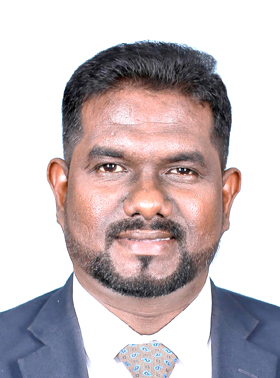
The Hon. Sundaralingam Pradeep - Deputy Minister of Plantation and Community Infrastructure
In the Committee Stage debate on the Ministry of Plantation and Community Infrastructure allocations, the Deputy Minister outlined Budget provisions of about Rs. 16,738 million for plantation crop development and social infrastructure in estate communities. He highlighted funding for vocational training, nutrition programmes for upcountry children, land deeds, roofing support, housing construction with Indian assistance, and the revival of institutions such as the upcountry new villages development authority. He also proposed improvements to schools, cultural centres, waste management, disaster relief, estate hospitals, pre-schools, drinking water and sanitation, with particular emphasis on replacing line rooms through single-house construction.
Verbatim record (translated)
Machine-translated from Sinhala / Tamil / English¶ 01 Hon. Presiding Member, I am pleased to participate in the committee stage debate on the allocations for the Ministry of Plantation and Community Infrastructure. The Ministry’s work spans two areas: plantation crops—tea, rubber, and coconut—and the social infrastructure of the people engaged in those industries. Historically, successive governments allocated very limited funds for these needs. However, through this Budget, our Government has allocated about Rs. 16,738 million, conferring significant benefits.
¶ 02 Additionally, about Rs. 8,815 million has been allocated for sectoral development including investments in plantation crops and institutions. For social infrastructure in the upcountry, Rs. 7,923 million has been allocated. About Rs. 1,800 million is allocated for vocational training for unemployed youth, land deeds, and roofing sheets for housing units. Health and nutrition among school children in the upcountry are unsatisfactory, with high levels of undernourishment; through this Budget we will implement programs to improve nutrition. Furthermore, for about 21,000 children under five, we have allocated around Rs. 650 million for a nutrition program—over and above the Triposha program.
¶ 03 A dark chapter in upcountry life is the line rooms. In my own constituency—Kavathai, Opavathai—there is a 60-room line house where people are confined within 120 square feet per household. I know well their daily lives and how critical individual housing is. Therefore, we are implementing the single-house program. Reviewing the incomplete Indian housing program of the past revealed poor construction, political interference, beneficiary selection errors, and incomplete infrastructure. To rectify this and resolve housing and land issues for upcountry people, the Government of Sri Lanka has allocated Rs. 4,267 million to complement India’s 10,000-house support. With this we will commence construction of about 4,700 new houses and fully complete 1,300, aiming to complete 6,000 houses within this year—the largest number ever built in history for upcountry Tamils in a single year.
¶ 04 We are also reviving NEVIDA—the upcountry new villages development authority—and allocating Rs. 417 million for the Sevumiyamoorthy Thondaman Memorial Council’s development. We are planning vocational trainings for youth and elevating courses to international standards. Compared to the past, our Government has allocated over Rs. 2,800 million additionally for upcountry people.
¶ 05 We plan to integrate upcountry culture and traditions into university curricula with special degrees by linking national universities to cultural institutions. We are modernizing the Irambodai Cultural Centre and the Norwood Grounds, turning them into useful venues for the community.
¶ 06 We will provide special trainings for mathematics, science, and ICT teachers in the upcountry. We will also address unresolved drinking water and sanitation issues in schools. Although over 800 schools have land, many still lack formal title; we will soon grant land titles to these schools.
¶ 07 Currently, only Rs. 10,000 is provided as relief for houses damaged by natural disasters in the upcountry. We will amend laws to provide the same level of assistance given elsewhere. Waste management programs are inadequate, causing public health issues; we will implement proper waste removal programs.
¶ 08 We are taking steps to bring estate and closed estate hospitals under Government control, so each hospital can serve local needs. In my area—Kavathai, Opavathai—an estate hospital that served both estate residents and Sinhalese villagers has been converted into a special forces camp and closed. Such hospitals should be taken over, staffed with MBBS doctors, and made operational within this year.
¶ 09 We will renovate and reopen pre-schools that are closed or at risk of closure. We are also consulting to provide drinking water and sanitation at resting places for upcountry mothers who contribute to export earnings.
¶ 10 Road development is a major need in the upcountry; we will address roads and electricity through budgetary and provincial allocations, including the Road Development Authority, to improve upcountry transport routes, and expand further based on need.
¶ 11 The desire to live in one’s own house is a long-standing aspiration of upcountry Tamils. Many mothers, fathers, and siblings toil in Colombo, other areas, and abroad to build homes, yet lack land titles. At the same time, Government officers living in line rooms should be provided with separate housing. Often, when people build on their own effort, estate management sues and takes the house—this is a grave injustice. Our goal is to grant ownership of the houses they have built.
¶ 12 Although statistics show 80 percent water coverage, access to clean, treated drinking water is very poor. The upcountry is water-rich, yet people struggle to obtain safe water, leading to disease. About 50 percent of schools lack drinking water. Even though the World Bank funded buildings at great cost, water facilities have not been provided; I place this on record.
¶ 13 Telecommunications and postal services remain inadequate; people still lack postal addresses. We will provide addresses through Clean Sri Lanka—this will be a great achievement for them.
¶ 14 Although 525 estate hospitals once existed with about 10,000 beds, after privatization many have quietly closed; maternity services are lacking and there are no MBBS doctors in estate areas. There are 275 nursing vacancies at Kilinochchi Hospital. Stunting is about 44 percent. The upcountry is overburdened with suicides, hunger, and unresolved issues. Our National People’s Power Government is focusing on these and will deliver solutions step by step.
¶ 15 In the North and East, palmyrah—an identity of Tamils—was once a major income source; during the war, many trees were destroyed. Today there are about 15 million palmyrah trees. Through palmyrah products and with diaspora investment, we plan to bring significant revenue, similar to tea, rubber, and coconut.
¶ 16 Finally, some in the Opposition still use ethnic and religious rhetoric, even though the people have rejected such politics. They think they can regain power by stirring communalism. The people have changed that political culture. Understand your role and act accordingly. Thank you.
Provenance
- Source
- Hansard, Friday, 14 March 2025 ·No. 1744281136023320 ·English daily/uncorrected Hansard
- Page · column
- not yet extracted — page/column anchors are not in the current dataset; the source PDF is the citable location.
- Permalink
/lk/speeches/26502
Cite as: The Hon. Sundaralingam Pradeep - Deputy Minister of Plantation and Community Infrastructure. 10th Parliament, Parliament of Sri Lanka. Hansard, 14 March 2025. No. 1744281136023320. Politick, https://staging.politick.io/lk/speeches/26502