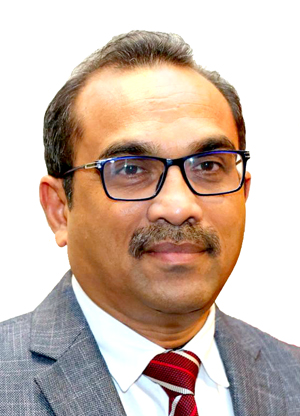
The Hon. Bimal Rathnayake - Minister of Transport, Highways and Urban Development and the Leader of the House of Parliament
Minister Bimal Rathnayake said CIABOC had strengthened Sri Lanka’s anti-corruption standing and that the proposed remuneration and service-condition measures would give it greater recruitment capacity and operational independence, including plans for district-level offices. He defended the Government’s QR fuel measures as a response to war-related global disruption rather than bankruptcy, contrasting it with the previous crisis and stating that fuel supply, harvesting activities, and electricity generation were being managed without a need for power cuts. He also referred to the Government’s handling of an incident involving Iranian vessels, saying Sri Lanka acted in line with international law and humanitarian obligations while avoiding alignment with parties to the conflict.
Verbatim record (translated)
Machine-translated from Sinhala / Tamil / English¶ 01 Hon. Presiding Member, first, I thank the Hon. Member from Trincomalee representing Ilankai Tamil Arasu Kachchi for his fair assessment—he appreciated CIABOC’s independence, autonomy, and freedom to recruit staff. Even when he critiques, his body language shows it is done in good faith. But there is a segment of the Opposition here that sees everything with malice, hoping that some missile like a Donald Trump missile will fall and return them to lost power. To them I say: learn how to act responsibly if you ever intend to govern.
¶ 02 Let me start with CIABOC. It is performing an exemplary anti-corruption task. Among the institutions that have most enhanced Sri Lanka’s reputation recently, CIABOC stands at the top. Sri Lanka is not free from bribery or corruption; globally, the law often fails to reach the “esteemed class.” Yet today, CIABOC has been able to apply the law in an orderly manner even against former Presidents and very powerful, wealthy individuals. According to the Corruption Perceptions Index, Sri Lanka climbed 14 places; in my view, at least 10 of those should be credited to CIABOC. Our political movement is anti-corruption; we have not stolen even 5 cents of public wealth, and we are strengthening the Commission accordingly.
¶ 03 Today’s practical step is to give CIABOC the hands and feet it needs—real control over recruitment and pay scales. Previously, CIABOC had to draw limited numbers of police officers on secondment for investigations without assurance of their integrity or specialized training. Under the Anti-Corruption Act, once we approve remuneration and service conditions, our anti-corruption struggle moves to a higher level. We plan to establish CIABOC branch offices across all 25 districts so that both the “big fish” and the smaller offenders in every region can be brought to book.
¶ 04 Now, to the global situation many discussed—hence the focus on QR codes and fuel. Remember: the prior QR came because of bankruptcy—engineered by Rajapaksas, Wickremesinghes, Premadasas, and Chandrikas—when the world had ample fuel and ships. The ships were even idling off Colombo, but we had no money to buy. Today’s QR arises due to war, not bankruptcy. People are afraid and stockpiling fuel because of trauma from that bankruptcy period. Even those who downloaded the QR are queuing because, as the saying goes, the man burnt by fire fears even lamplight. We understand this. Deputy Minister Eranga Weeraratne explained clearly this morning: in the previous era they gave 14 days to acclimatize to QR. We are introducing QR in an economy growing at 5.2%, unlike then when it was in contraction. Harvesters are operating—no stoppage in Anuradhapura or Mannar. This QR is due to a war created by reckless global actors, not our domestic mismanagement, and we are managing the situation.
¶ 05 The first direct impact we faced—before the fuel question—was the incident involving the Iranian vessels. We have powerful regional actors in our vicinity, but even more sensitive was rescuing the Iranian crews, upholding international law, and avoiding giving special harm or benefit to any party in conflict with the United States. The President and Government managed that extremely well—far more complex than fuel logistics and handled deftly.
¶ 06 You cannot foresee every such incident. No major power stepped forward to act; a leader of a tiny island nation did. Because of that decision, many South Asian countries have praised Sri Lanka; international media recognized it recently. The political capital from this humane, lawful intervention will last for decades.
¶ 07 Some ask why we did not pre-announce stock levels. You cannot pull down your pants while commanding seven fathoms of sea. Constantly declaring, “We have so much fuel,” distorts the economy and business planning. We responsibly state: there is no need for power cuts. We are preparing, but there is no need for electricity cuts.
¶ 08 Hon. Presiding Member, the Commissioner General of Essential Services issued a media release on 17 March 2026: Wednesday is declared a compulsory Government holiday; all State ceremonies are suspended until further notice; the holiday applies to all State institutions including Parliament, boards and authorities; it applies to courts as well; to State, semi-State, private and international schools, preschools, pirivenas and educational institutes; all tuition classes are suspended and tutors requested to cooperate; the private sector is requested to deploy staff to work online through the Ceylon Chamber of Commerce and Employers’ Federation. However, this does not apply to essential services such as health, banking, insurance, electricity, water, ports, customs, aviation, airports, and import/export services; other services are at the discretion of secretaries considering necessity.
¶ 09 Further, the President presented a Cabinet communication. Three Committees were approved yesterday: - Energy Committee, chaired by Hon. Wijitha Herath, with Dr. Anil Jayantha, Hon. Kumara Jayakody and officials. - Committee to ensure continuity of the Public Service, chaired by Hon. (Dr.) Harini Amarasuriya, with Prof. Chandana Abeyratne and others. - Committee for Release and Supervision of Essential Commodities, chaired by me, with Ministers Wasantha Samarasinghe, Lal Kantha, Sunil Handunnetti, Ramalingam Chandraseker, and Deputy Minister of Tourism Ruwan Ranasinghe.
¶ 10 We have already convened these committees and taken decisions. None of the internal issues were caused by us. We came to power with a broken economy; now growth is at 5%. Only the Opposition refuses to accept what international institutions acknowledge. When IMF MD Kristalina Georgieva said Sri Lanka is performing better than expected, an Opposition MP called white people “generally foolish.” Despite such absurdities, we managed every internal issue with sound plans. The “Ditcha” cyclone was an external shock, which we managed while rebuilding. Regarding the Iran–Israel war, those expecting chaos saw nothing of the sort. We are managing that well too. You took more than two weeks to register for QR and now complain. The data infrastructure you left was in tatters due to corrupt tenders; we have now provided full vehicle data to the Digital Economy Ministry, completed last night at 10 p.m. Look—are there bus queues today? There are no such queues, only isolated issues.
¶ 11 We assure the public: we are managing this as best as possible. We aim to resolve the main QR issues within a day—by tomorrow night at the latest. We recognize this is not normal; special conditions apply, and we will minimize the pain.
¶ 12 On the Business Committee’s recommendation to make Wednesday a holiday for Parliament too: the Opposition objected, alleging an attempt to silence Parliament. Yet Parliament is sitting today and will sit on Thursday and Friday as well, even though there is a Ramazan holiday; Parliament will not be closed for that. We are only pausing Wednesday to conserve fuel, as most parliamentary staff use public transport. The President will address Parliament on Friday, and he will engage the public via media at 7.30 p.m. tonight. If Opposition party leaders remain on Friday, they can have a discussion with the President. Finally, we know the public’s pain. This is an external shock. There were inadequate facilities to store even small quantities of fuel—figures were given by the President in this House. We will manage this crisis just as we have managed all others, minimizing public hardship. QR codes are being issued; please do not create unnecessary panic. A constituent from Vavuniya told me he still has the petrol he bought during COVID at home—that kind of hoarding is not necessary. We will provide fuel in an orderly way. Thank you.
Provenance
- Source
- Hansard, Tuesday, 17 March 2026 ·No. 23387 ·English daily/uncorrected Hansard
- Page · column
- not yet extracted — page/column anchors are not in the current dataset; the source PDF is the citable location.
- Permalink
/lk/speeches/3097
Cite as: The Hon. Bimal Rathnayake - Minister of Transport, Highways and Urban Development and the Leader of the House of Parliament. 10th Parliament, Parliament of Sri Lanka. Hansard, 17 March 2026. No. 23387. Politick, https://staging.politick.io/lk/speeches/3097