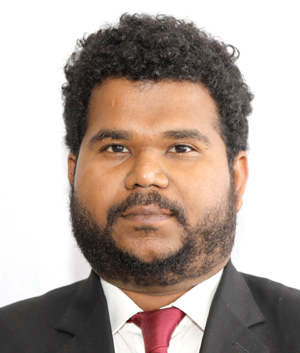
The Hon. Thanura Dissanayake
Hon. Thanura Dissanayake said energy policy should ensure affordable, reliable and quality supply, supported by a publicly centred institutional structure. He stated that the Government revised an earlier draft law by restructuring the sector into four core State-owned entities for generation, transmission, distribution and system operation, while emphasizing the need for stronger transmission and distribution investment, particularly to integrate renewables and improve rural service. He argued for cost-reflective utility management with transparent Treasury-funded targeted subsidies, and outlined priorities including renewable expansion, grid-scale storage, green hydrogen and power-to-X technologies.
Verbatim record (translated)
Machine-translated from Sinhala / Tamil / English¶ 01 Hon. Presiding Member, today’s Committee Stage debate concerns the vital energy sector. Two fundamentals guide us: energy must be affordable to consumers, and it must be supplied reliably, steadily, and with quality. This sector underpins both the economy and public welfare.
¶ 02 We are moving toward a publicly centered energy architecture with clear business models, competition frameworks, and institutional structures. The earlier Ranil–Kanchana draft law proposed 12 entities without clarity on State ownership and energy sovereignty. We corrected that by unbundling into four core State-owned entities: Generation, Transmission, Distribution, and System Operator. Unbundling is an institutional design; technologies can vary within generation, across thermal or renewables.
¶ 03 Investment has been uneven—generation drew more, while transmission lagged. Without robust transmission, adding solar and wind in remote areas will not help; we need a backbone. Hence the heightened focus—and budget allocations—on transmission now. Distribution quality, especially in rural and difficult areas at peak times, also needs upgrades through planned investments and better management.
¶ 04 We must run this sector on sound policy and business principles—cost-reflective and sustainable—rather than ad hoc political pricing that bankrupted utilities. Targeted subsidies should flow transparently from the Treasury to deserving sectors like fisheries and select industries, without undermining utility finances.
¶ 05 Our goals ahead: expand renewables, deploy grid-scale storage to manage peaks, and explore emerging technologies including green hydrogen and power-to-X. With proper planning and policy, we can reduce tariffs and deliver a stable, quality service. I thank the Minister and institutions working toward this.
Provenance
- Source
- Hansard, Thursday, 20 November 2025 ·No. 22934 ·English daily/uncorrected Hansard
- Page · column
- not yet extracted — page/column anchors are not in the current dataset; the source PDF is the citable location.
- Permalink
/lk/speeches/4464
Cite as: The Hon. Thanura Dissanayake. 10th Parliament, Parliament of Sri Lanka. Hansard, 20 November 2025. No. 22934. Politick, https://staging.politick.io/lk/speeches/4464