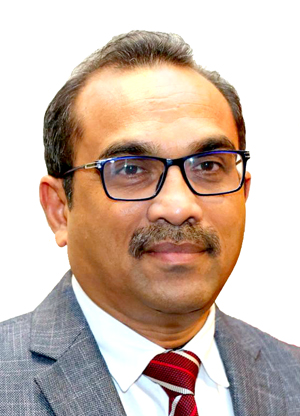
The Hon. Bimal Rathnayake
The Hon. Bimal Rathnayake defended the President’s declaration of essential public services under the Essential Public Services Act in response to Cyclone “Ditcha,” arguing that emergency powers are necessary to procure and restore critical services disrupted by the disaster. He said the Government would use these powers only for disaster management and outlined progress in relief payments, while noting that eligibility verification is required for public funds. He cited survey findings and international comments to support the Government’s relief performance, rejected Opposition criticisms and rumours about returned reconstruction cheques, and called for factual assessment of the post-disaster response.
Verbatim record (translated)
Machine-translated from Sinhala / Tamil / English¶ 01 Hon. Speaker, under powers entrusted by Section 2 of the Essential Public Services Act, No. 61 of 1979, the President has declared, considering the post-disaster situation created by Cyclone “Ditcha” and the need to restore normal life, that services provided by any state corporation, government department, provincial council institution, cooperative society or their branches relating to the following are essential public services for the purposes of the said section: all services relating to electricity supply; all services relating to agriculture and agricultural insurance; all services relating to highways; all services relating to telephone, telegraph and media; all services relating to land reclamation and development; ambulance services; all state banks including the Central Bank of Sri Lanka and insurance services; and other listed services.
¶ 02 The President’s declaration also states that, to ensure continued provision of services disrupted by Cyclone “Ditcha,” services may be procured from anywhere necessary for restoration purposes. Without a state of emergency, this cannot be done. The Opposition must say if there exists any other legal route to ensure these services; otherwise there is no argument. The objective is expressly tied to the post-disaster context caused by “Ditcha.” The cyclone lasted two days; the post-disaster impact lasts years. Even today we are rebuilding houses for affected people—this morning we began in Kandy District, including Kundasale and later in the evening Galagedara—resettling families on safer land. The Government’s position is clear: emergency powers will be used only for disaster management, nothing else.
¶ 03 On assistance, our reports show Rs. 25,000 grants have reached 90% of eligible, Rs. 50,000 to 80%, and Rs. 15,000 for schoolchildren to substantial numbers. We too wish to reach the remaining 10–20%, but you know not all applicants qualify; public funds require verification. Even if generosity is high, distribution must follow criteria. Therefore, the shortfall does not mean incompetence or unwillingness. Some Grama Niladhari and Divisional Secretaries have said certain applications do not qualify. In one GN division in Mannar, the officer said even Vesak dansala food would not be enough if one tried to satisfy all applicants—there are simply more applications than entitlements. Criticism for political gain is mere cynicism.
¶ 04 Recently the Sociologists’ Association conducted an online district-level survey on post-“Ditcha” disaster relief. It shows several areas performing at very good levels, some at good levels. One must accept facts—both successes and errors—seek truth from facts, as Deng Xiaoping popularized.
¶ 05 On the Opposition’s performance during the cyclone, only about 24% of respondents expressed any approval; 76% did not. Parliament allows anyone to speak, but the real test is outside, where only 24% show approval. We read people’s reactions in their faces and lives. Young councillors and many without office worked tirelessly.
¶ 06 This country’s strength and discipline deserve global recognition. The UN Resident Coordinator, Marc-André Franche, publicly said Sri Lanka’s disaster relief at times surpassed even his own country’s. The Sociologists’ Association says so; the UN says so; many world leaders say so. Who then refuses to acknowledge it?
¶ 07 Some tried to circulate a story that a cheque given by the President had been returned. Members of both SJB and Pohottuwa rejoiced more at that rumor than at a World Cup! Bring those returned cheques here and table them—I challenge anyone. They cannot, because they do not exist. What happened was that district secretaries instructed banks to verify whether recipients had land allocated and rooms or toilets made ready before depositing larger reconstruction grants—public money must be safeguarded. A mother’s voice clip was exploited; she herself said someone just grabbed a quick recording. Irresponsible rumor-mongering is unacceptable.
¶ 08 We expanded the Opposition from 3 to 159 by working seriously: studying, debating, attending committees—never resorting to vulgarity. Yet what have we faced? Abuse—against the Prime Minister, the Speaker, the Speaker’s Secretary. Some seem obsessed with obscenity and sexual innuendo, seeing vulgarity everywhere, even imagining impropriety when two boys hold hands. Such conduct disrespects the people who elected them. Women MPs face this abuse too. This House includes parents and elders; this profanity is unprecedented. Do not try to destroy our minds with this filth.
¶ 09 We have not used emergency powers for any anti-democratic purpose. Let me table two global references. One states: “Sri Lanka’s global standing in democracy and the rule of law has seen a notable upward shift as of 2025–2026. While the country still faces structural challenges, recent reports highlight it as an exception to the global trend of democratic backsliding.” By data: our global democracy rank improved by 15 places to 58 in 2025 from 2024, now among the top 25% in civic engagement and electoral participation.
¶ 10 On rule of law, according to the WJP Index, Sri Lanka ranks 74 out of 143 globally, second in South Asia; 64th on fundamental rights; 78th on absence of corruption; 86th on order and security—improving across indicators. Judicial independence per the International Property Rights Index (2025): ranked 59th globally. These are independent sources: International IDEA places us 58 of 173 on democracy; WJP Rule of Law places us 74 of 143 with a 1.1% uptick; IPRI judicial independence 59 of 126; Freedom House shows civil liberties at 58/100. We can debate methodologies, but even by metrics the Opposition used to champion, Sri Lanka has advanced.
¶ 11 The Rule of Law Index further notes declines globally that did not occur in Sri Lanka: freedom of opinion and expression declined in 73% of countries; freedom of assembly/association declined in 72%; civic participation declined in 71%; civil justice weakened in 68%—but not in Sri Lanka.
¶ 12 A Member spoke on the Easter attacks, suggesting cases are being heard “daily, in a jungle court, from a Minister’s bungalow,” with witnesses and counsel inconvenienced, and that cases proceed without the main suspect. Deconstructing such text shows an intention: to delegitimize proceedings so that when criminals are convicted, one can call it a “jungle court.” Ex parte trials occur when accused abscond or cannot be apprehended—then judgments can be made accordingly.
¶ 13 I challenge the legal fraternity, scholars, victims, and His Eminence the Cardinal: we work to find the truth and punish perpetrators. But examine the intention behind belittling courts and expediting trials. Is using state premises temporarily to speed trials for Easter victims good or bad? Should we instead give court dates every few months in Aluthkade and drag on for years? I can smell the political agenda here: to protect the true masterminds. We know who drove the country to this tragedy.
¶ 14 I have observed a pattern: when we previously debated emergency regulations, the same party attacked investigators like Shani Abeysekera and Ravi Seneviratne. Today, some speak from within the pockets of killers, undermining proceedings internationally by saying cases are in “Minister bungalows.” No global journalist asks if those buildings were formerly state residences now repurposed as courts to clear massive backlogs—they only hear the Opposition’s slur. The aim is obvious: to stand with murderers of Easter Sunday.
¶ 15 Our strategy is facts. Our judicial reforms are about speed and access. The Government has opened new courts using state facilities to expedite trials. We will not be deterred.
¶ 16 Politically, since the 1980s–90s, a strategy emerged: when you cannot reform yourself to be cleaner, more competent, or less nepotistic, you drag your opponent into the mud—“if we are corrupt, so are they.” This is the playbook of the Rajapaksas and, sadly, others. We, the JVP/NPP, took a different path: lived among the people, showed by our lives we could be better. That is why we went from 3 to 159.
¶ 17 A concrete example: in 2016 a Chinese company built a road properly, leaving a saving of Rs. 550 million. The RDA then proposed a tunnel using those savings. The then Highways Minister told the Chinese contractor he’d approve if they paid him Rs. 50 million. The company refused. Today, ten years later, we have laid the foundation and are building that tunnel with state funds. This is the past you want us to imitate? No. Their strategy remains to sling mud so that people think all politicians are alike.
¶ 18 Some ex-Ministers, now jailed, once told me during a TV break that their “project” was to accuse us of the same wrongs they committed. They target even the Speaker—while former Speakers presided over disgraceful episodes. Audit reports show, for example, SriLankan Airlines Board met at the Speaker’s official residence in one past era to take dubious decisions; laptops went missing; family trips were arranged. Do not project that past onto a Speaker who works with integrity. We chose this path not to enrich ourselves but out of vocation. If we wanted to steal, many here would be better at it—but we won’t.
¶ 19 Their current strategy is to lump us in: “If we stole, you stole.” They failed before and will fail again. From prisons to the Presidential Secretariat, we have shown we can work cleanly in all seasons. Do not be swayed by lies about this Government.
¶ 20 They even claimed we were closing the Faculty of Dental Sciences at Jayewardenepura. We are a movement that fought for free education; under us, faculties open, not close.
¶ 21 A final word to the Opposition: try to be better than us—less corrupt, more competent, no nepotism. Win power by virtue. Do not undermine national occasions with petty comments about the President’s or Prime Minister’s attire or chairs. Authority comes from content, not costumes. Our leaders have substance; accept that.
¶ 22 Some say the Independence Day ceremony lacked dignity; they nitpick photos, saris, seating. Those who lack inner stature search for it in chairs, clothes, sunglasses. We do not.
¶ 23 Respect your opponents. You will not win the new generation with petty politics. Today even your own Chief Organizer was praised for qualities we should acknowledge; only a good person can appreciate another’s goodness. Stop turning this House into a mud pit.
¶ 24 The Rajapaksa family, declared by the Supreme Court as responsible for economic crimes, now lectures as if saintly. Basil Rajapaksa avoids court—but if our global judicial independence has improved, come and prove your case. Do not hide. They bankrupted this country and still speak of national pride. True pride is measured by international indices I cited. On democracy, rule of law, and judicial independence, Sri Lanka has improved. That is how national dignity grows; economic progress is another pillar.
¶ 25 Those who defend Easter perpetrators are political criminals. They crop photos of small gatherings to pretend 10,000 attended. We challenge Namal Rajapaksa and others: wait for March 8.
¶ 26 Some claim we disrespect the armed forces. We respect the tri-forces and police, including their work during Cyclone “Ditcha.” But who dragged the military’s name through mud? Who imprisoned General Fonseka? Who drove respected commanders like Mahesh Senanayake into exile? Under the Rajapaksas, service personnel were used for private errands—rugby matches, personal shows—and the post-war abuses stained our forces internationally: white vans, abductions, murders like that of Lasantha Wickrematunge, the Trincomalee 11, and the looting of civilians’ gold. We are now auditing and regularizing the return or dedicated use of recovered gold for development funds benefiting the North and East, with lab verification and transparent processes—what previous governments failed to do.
¶ 27 The Opposition today, out of spite, labels fast-track courts as “jungle courts.” The people can see: you have knelt politically to defend murderers. With that, I conclude. Thank you.
Provenance
- Source
- Hansard, Friday, 6 February 2026 ·No. 23270 ·English daily/uncorrected Hansard
- Page · column
- not yet extracted — page/column anchors are not in the current dataset; the source PDF is the citable location.
- Permalink
/lk/speeches/4734
Cite as: The Hon. Bimal Rathnayake. 10th Parliament, Parliament of Sri Lanka. Hansard, 6 February 2026. No. 23270. Politick, https://staging.politick.io/lk/speeches/4734