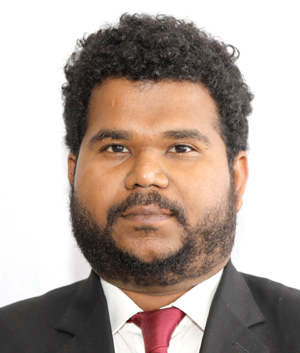
The Hon. Thanura Dissanayake
Hon. Thanura Dissanayake defended the Government’s policy and rejected Opposition criticisms, including claims about vehicle procurement and state institutions’ performance. He explained that the 2024 No. 1 Regulations on Shared Use of Telecommunications Infrastructure would allow the TRCSL to regulate infrastructure sharing, pricing, feasibility and dispute mediation to improve service quality and reduce capital costs. He said the Government is expanding rural connectivity through the “Gamata Sannivedanaya” programme, with 79 towers built and 150 more targeted, and is introducing licensed infrastructure providers to accelerate telecom development. He also noted that 5G deployment requires regulated sharing to avoid excessive urban infrastructure, visual pollution and environmental impact.
Verbatim record (translated)
Machine-translated from Sinhala / Tamil / English¶ 01 Hon. Presiding Member, to me, the Opposition either does not know today’s topic or has come by habit, with no relevance to the subject. They spoke a heap of untruths, including about 1,700 cabs. There are only 225 MPs; why 1,750 cabs? They come here without knowing what happened in between; they have not even listened to the Appropriation debate; yet they talk. Everyone knows the cabs are to fill shortages across the State machinery. They do not even come to Coordinating Committee meetings. How can they know issues then—on ground infrastructure, public servant transport, health sector vehicles like MOH vehicles? These are the people who ran this country all this time.
¶ 02 There is the chief of lies—MP Chamara Sampath from Badulla. As soon as he speaks, a TV channel broadcasts his voice-cut. But they do not air the replies. He even spoke about a sugar shop being closed; likely he was in a no-signal area when fake news spread and he saw a closure. The company has corrected it with a media release; he must have missed it. That is why we want to fix the signal—because where they go, signal is missing. They get fake social media news, but not the truth. Perhaps they are infected by their own algorithm.
¶ 03 Let the Government side speak on the 2024 No. 1 Regulations on Shared Use of Telecommunications Infrastructure, since the Opposition barely touched it. People need to know what is happening.
¶ 04 Telecommunications is no longer a niche. It is everywhere. There are 8,633 telecom towers across the 25 districts—owned by various entities, including multi-purpose poles. You see towers everywhere. The issue is often quality: data transfer, continuous service, speed—especially in the hills.
¶ 05 This is an industry. Companies want to deploy capex efficiently. When a company builds towers and infrastructure and uses it alone, it is not economically efficient. So they enter agreements to share facilities—towers, power, generators. But we lack a clear regulatory view on infrastructure sharing. Because it is both an industry and a vital service, it must be regulated. If capex rises and agreements are not regulated, prices go up. We must both improve service quality nationwide and reduce prices; that requires reducing capex via regulation. These Regulations now allow the TRCSL to intervene—to do feasibility, regulate pricing, and mediate.
¶ 06 An Opposition MP said everything is collapsing and all entities are in loss. Perhaps they see the world in reverse. The TRCSL earned Rs. 37 billion in 2024, with Rs. 8.6 billion expenditure; projected Rs. 45.3 billion revenue and Rs. 5.4 billion expenditure in 2025. The reality is clear.
¶ 07 Our “Gamata Sannivedanaya” (Connectivity to the Village) project arose from ground realities. When a new company seeks sites, problems arise; the best locations have been taken; to get new sites, you need 21 approvals—taking about 10 months; capex rises. So with TRCSL, as per our policy statement on sharing, we have planned new towers especially in rural areas. We built a number last year; in total, 79 towers have been built, with another 150 targeted this year.
¶ 08 We are also enabling a new class of infrastructure providers. Until now, only telecom service providers built infra. Now, even an entity without spectrum or a network can be licensed to build infrastructure—reducing operators’ burden and accelerating development. They can negotiate resilient sites. In recent cyclones, fibre was cut; fuel was short; generators went offline; without fibre, you cannot connect to the core. Infra providers can build, and via agreements, provide connectivity to operators.
¶ 09 We have moved from 2G/3G/4G to 5G. 5G requires dense poles, often on buildings, affecting cityscapes and visual pollution. If all operators install their own 5G poles, towns will fill with poles. We must think beyond that—protecting the environment, reaching common agreements, and regulating under these Regulations. The aim is quality, environmental protection, reduced capex, and lower prices to the public—advancing digitalization and the digital economy. These Regulations empower TRCSL accordingly. That is our core need.
¶ 10 Thank you.
Provenance
- Source
- Hansard, Tuesday, 3 February 2026 ·No. 23252 ·English daily/uncorrected Hansard
- Page · column
- not yet extracted — page/column anchors are not in the current dataset; the source PDF is the citable location.
- Permalink
/lk/speeches/8821
Cite as: The Hon. Thanura Dissanayake. 10th Parliament, Parliament of Sri Lanka. Hansard, 3 February 2026. No. 23252. Politick, https://staging.politick.io/lk/speeches/8821