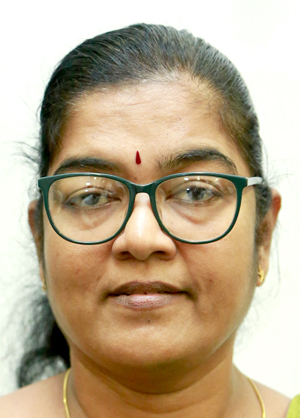
The Hon. (Mrs.) Saroja Savithri Paulraj - Minister of Women and Child Affairs
The Minister, speaking in the adjournment debate on the 2019 Easter Sunday attacks, recalled the deaths, injuries, and subsequent social distrust, particularly the suspicion faced by Muslim communities and women wearing Islamic attire. She argued that politicians had exploited language, ethnicity, and religion for power, drawing parallels with Sri Lanka’s war experience and global conflicts in which civilians became victims. She stated that the Government is committed to social justice, equal citizenship for Sinhala, Tamil, and Muslim communities, and ensuring justice and punishment for those responsible for the Easter attacks.
Verbatim record (translated)
Machine-translated from Sinhala / Tamil / English¶ 01 Hon. Presiding Member, on the adjournment debate regarding the Easter Sunday attacks of 21.04.2019, I wish to share my thoughts. Eight locations were attacked; 274 people died; 592 were seriously injured. Six years have passed. Beyond the crimes and the ensuing economic damage, we must consider how vast the social tragedy was—how distrust and conflict among people grew over these six years.
¶ 02 On that day, I was a teacher and had gone to the University of Kelaniya for a course. The bombs exploded that Sunday morning; all universities and institutions were suddenly closed and curfew was imposed. A Muslim friend studying with me was with me that day; we both traveled home in fear. I have faced such climates before, even as a child.
¶ 03 In 1983, as a schoolgirl, I experienced how war-related pressure affected society. My mother did not speak Sinhala well; yet I saw how even the way people looked at a Sinhala-speaking person changed, how mistrust hurt. Later as a teacher, I held my Muslim friend’s hand through that fear. The hijab and Islamic attire became targets of suspicion after the attacks; I saw how Muslim women suffered simply for their dress. No one speaking now spoke then; but we did.
¶ 04 Schools feared bombs; parents came to guard schools; in the South, there was even fear to have Muslim mothers help guard schools. We, the teachers, taught children that no innocent person should be victimized by terrorism. Yet today, those who kept silent then pose as heroes and question us, who spoke up for people’s rights.
¶ 05 Globally, in struggles for power—by parties, camps, or ideologies—the innocent become victims. The Catholic community in Sri Lanka has not historically been part of conflicts; I taught in a Catholic school where Catholics were a minority among mostly Buddhist students, with some Muslim children too. All had freedom of worship; I was the sole Tamil-speaking teacher, and I cherished the children’s innocent love. We taught coexistence. But politicians who gambled with innocent lives for power trained people to suspect one another, even those who ate together. We oppose that.
¶ 06 Our movement in power is committed to social justice: ensuring justice for Easter victims and punishment for perpetrators is not mere rhetoric. War drags societies backward, destroying intellectual capital. The decades-long war cost Sri Lanka immeasurably in lost knowledge and people who left; that cannot be priced.
¶ 07 We must also recognize global tragedies: millions of civilians died in wars—Vietnam, Afghanistan (1978-1987: around 876,000 unnatural deaths), Iran-Iraq (1980-1988: around 500,000), Gulf War (1990-1991: 20,000-35,000 Iraqi deaths), Rwanda (around 800,000 Tutsi/Hutu killed), Bosnia (over 100,000), Second Congo War (3.8 million), Israel-Palestine (around 186,000 deaths; around 127,000 injured; about 55,000 Palestinians killed), Syrian Civil War (6.5 million displaced), Yemen (about 4.5 million affected; 80% women). For these displaced and innocent victims, what is our responsibility? We must end the politics of power that turns innocents into victims.
¶ 08 Personally, even when everything before me burned, I did not become a chauvinist. Our political movement remains non-extremist. We speak not for one faith, ethnicity, or language, but for all—Sinhala, Tamil, Muslim—to live equally.
¶ 09 I end with the words of my teacher, Prof. Yogarajah: Tamils are most sensitive to language, Sinhalese to ethnicity, Muslims to religion. Politicians weaponized this: to hurt Tamils, attack language; to hurt Sinhalese, attack ethnicity; to hurt Muslims, attack religion. They exploited it, while innocent people did not realize. We must affirm that justice is not for individuals alone but for society as a whole.
¶ 10 Justice must be done for all. A National People’s Power government will ensure justice and punishment for the Easter crimes. Finally, we are all citizens of one country—Sinhala, Tamil, Muslim. Let us end this tragedy here. We promise to deliver justice and fairness to victims and punish offenders.
Provenance
- Source
- Hansard, Wednesday, 9 July 2025 ·No. 1752660241032216 ·English daily/uncorrected Hansard
- Page · column
- not yet extracted — page/column anchors are not in the current dataset; the source PDF is the citable location.
- Permalink
/lk/speeches/9385
Cite as: The Hon. (Mrs.) Saroja Savithri Paulraj - Minister of Women and Child Affairs. 10th Parliament, Parliament of Sri Lanka. Hansard, 9 July 2025. No. 1752660241032216. Politick, https://staging.politick.io/lk/speeches/9385