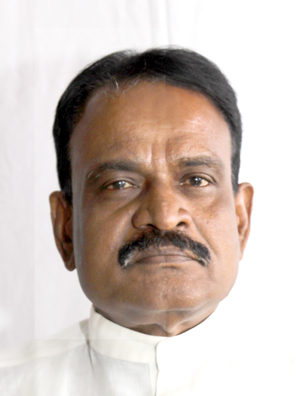
The Hon. Gnanamuththu Srineshan
Gnanamuththu Srineshan supported the President’s policy commitment to reject ethnic and religious extremism and strengthen the rule of law, while arguing that past governments wasted major mandates without resolving national issues, especially the ethnic question. He called for accountability for assassinations, disappearances, journalist killings, and the Easter attacks, including consideration of Asad Moulana’s testimony, and urged enforcement of court orders against illegal settlements in Mayilathamadu and Maathavanai. He welcomed the President’s recognition of the right to memorialize the dead, but expressed concern that the policy statement was silent on a political solution to the national question and did not propose a common ministry to treat all religions equally.
Verbatim record (translated)
Machine-translated from Sinhala / Tamil / English¶ 01 Hon. Deputy Speaker, recently, President Anura Kumara Dissanayake delivered his policy statement in this House. Its contents are now under discussion here.
¶ 02 In our history, people have given opportunities to different parties—UNP, SLFP, SLPP—to solve national problems. Those majorities were squandered, and parties that once held overwhelming power now have only three to five seats and sit in Opposition.
¶ 03 In 1977, J. R. Jayewardene’s party won 140 of 168 seats—a five-sixths majority—but did not solve the ethnic problem and left as ordinary politicians. In 1994, Chandrika Bandaranaike Kumaratunga won approximately 62.28 percent of the vote and was given a mandate to solve national issues; that opportunity, too, was lost. In 2015, Maithripala Sirisena and Ranil Wickremesinghe were also given a chance, which they failed to utilize. In short, the principal parties—UNP, SLFP, later SLPP—were repeatedly given chances but achieved nothing worthy of historical note.
¶ 04 This time, the Left—National People’s Power—has been given the mandate. The President says, and the results show, people from North, East, South, and West voted for him. The local and international community are watching closely to see how the President and the NPP use this opportunity to alleviate the people’s suffering. If they use this five-year window properly, their names will be recorded in history. I extend my congratulations. I also thank the voters of Batticaloa District—Kalkudah, Paddiruppu, and Batticaloa electorates—who elected me.
¶ 05 Our President is different—simple, unpretentious, and did not burden the public with lavish celebrations. His work appears simple and dedicated; it must now yield benefits for the people. I read his policy statement fully. I welcome his assertion that there will be no more ethnic or religious chauvinism or fundamentalism in politics. The Minister of Health and Mass Media and Cabinet Spokesman, Hon. (Dr.) Nalinda Jayatissa, also said there is no room for ethnic or religious extremism. We appreciate this.
¶ 06 Another important point: the President said the rule of law must be strengthened; he acknowledged its weakness. Because of weak rule of law, many crimes occurred— even the Easter bombings were a product of such weakness. From 2005 to 2015, numerous killings occurred: over forty journalists murdered; our TNA senior leader Joseph Pararajasingham was assassinated; Raviraj, who was a praiseworthy human being, was assassinated in Colombo; former MP Chandranehru (from Ampara, and uncle of Hon. Kodeeswaran seated here) was assassinated; Sivanesan was assassinated in Vanni; Professor Ravindra (former Vice Chancellor of the Eastern University) was abducted and killed; Sivaram (Taraki), senior academic Nadesan, Prageeth Ekneligoda, Lasantha Wickrematunge—many were murdered. Yet perpetrators remain unpunished. With such impunity, can we say we have democracy? In truth, “money-ocracy” ruled, and corpses filled the streets.
¶ 07 Those who committed grave crimes and wandered as “honourable” impunities must now be brought before the law and punished to strengthen rule of law. Some offenders even adorned this Parliament. Regarding Easter, Asad Moulana has given extensive testimony; those testimonies must be considered to identify perpetrators and masterminds and ensure justice.
¶ 08 There is also unlawful settlement in areas like Mayilathamadu and Maathavanai—people crossing district lines to encroach. Courts have thrice ordered eviction of illegal settlers who seized lands and destroyed livelihoods, but past rulers did nothing. I urge action to enforce these orders.
¶ 09 Hon. Deputy Speaker: Hon. Srineshan, your time is up.
¶ 10 Sir, one more minute, please. The President spoke of progressive matters, but on the national question and its resolution, there was silence. He also did not propose a common religious affairs ministry to treat all religions equally—this is disappointing.
¶ 11 He affirmed the right to memorialize the dead. Yet recently, in Kokkatticholai, Mr. Narayanan, who remembered his deceased sister during a protest, was summoned by CID-TID to the 4th floor. Sometimes, even when the Government intends to do right, certain officials act in ways that tarnish it. Intimidation of innocents must end.
¶ 12 Another matter: near the Batticaloa airport, a public road was closed in 1986 during war. Fifteen years after the war ended, it remains closed, forcing people to navigate eight bends and causing hardship. Reopen that public road.
¶ 13 Recent floods severely affected farmers, fishermen, shrimp cultivators, and daily wage workers; roads and bridges were damaged. We need remedies and support to rebuild livelihoods. Thank you.
Provenance
- Source
- Hansard, Thursday, 5 December 2024 ·No. 1734081038099638 ·English daily/uncorrected Hansard
- Page · column
- not yet extracted — page/column anchors are not in the current dataset; the source PDF is the citable location.
- Permalink
/lk/speeches/12563
Cite as: The Hon. Gnanamuththu Srineshan. 10th Parliament, Parliament of Sri Lanka. Hansard, 5 December 2024. No. 1734081038099638. Politick, https://staging.politick.io/lk/speeches/12563